info
Access Athinia Catalyst at catalyst.athinia.io.
Study data answers
When you open Assist from within a study, you can ask about that study's data in plain language — "average overlay error by tool?", "how many wafers failed process control?", "distribution of risk score by lot" — and Assist queries the dataset to answer.
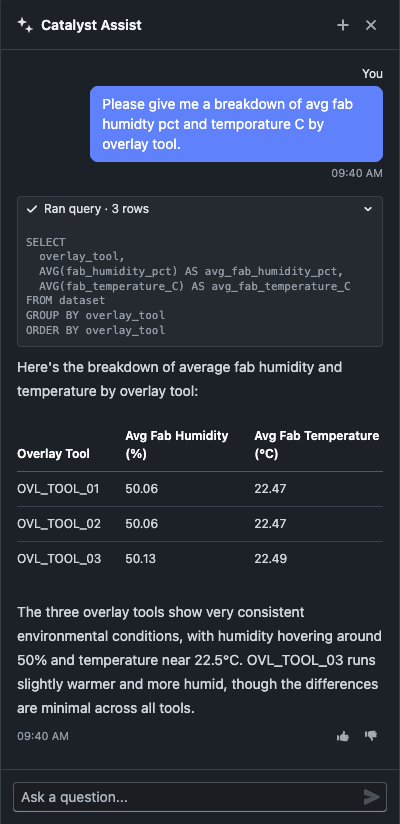
A data answer: the query result shown as a markdown table with a brief takeaway.
When it's available
- Inside a study. Outside a study, Assist still answers platform questions but has no dataset to query.
- With a running worker. Queries run on the study's compute. If the worker isn't active, Assist says to start it, and answers only platform questions until then.
How it works
- Your data becomes a queryable table. When Assist opens in a study, the dataset is exposed to it as a table named
dataset, with its column list, so Assist knows what it can ask about. - Your question is translated to a query. Assist writes a single read-only SQL query (Polars SQL dialect) over
dataset. - The query runs on your study's worker, isolated so it can only read your study's dataset and cannot modify anything.
- The answer is computed from the result. Assist states the result and the conditions it covers, with at most one brief takeaway from the returned rows. Multi-row results are shown as a table.
- It self-corrects. If a query errors, Assist reads the error and retries with a corrected one.
What it respects
The columns Assist can query come from your study's column configuration, not from the chat:
- Visibility: hidden columns are excluded; Assist can't query or return them.
- Display names: columns use their configured names, so you can ask using the terms you see in the study.
- Data types: columns use their configured types, so numeric, categorical, and date operations behave correctly.
What you can ask
- Aggregates and breakdowns: "average yield by site", "count of failures by category".
- Filtered questions: "how many wafers exceeded the spec limit?".
- Dates and durations: group by year, compare timestamps, measure time between events ("average days between start and completion?").
Notes and limits
- Data answers come only from your dataset. Assist never invents or estimates figures; if the data doesn't answer your question, it says what the data does and doesn't show.
- Results are capped. Large results are truncated to a sample for display, and Assist flags when this happens. Ask a more aggregated question (counts, averages, top-N) for the full picture.
- AI responses may not always be accurate; verify important results.